
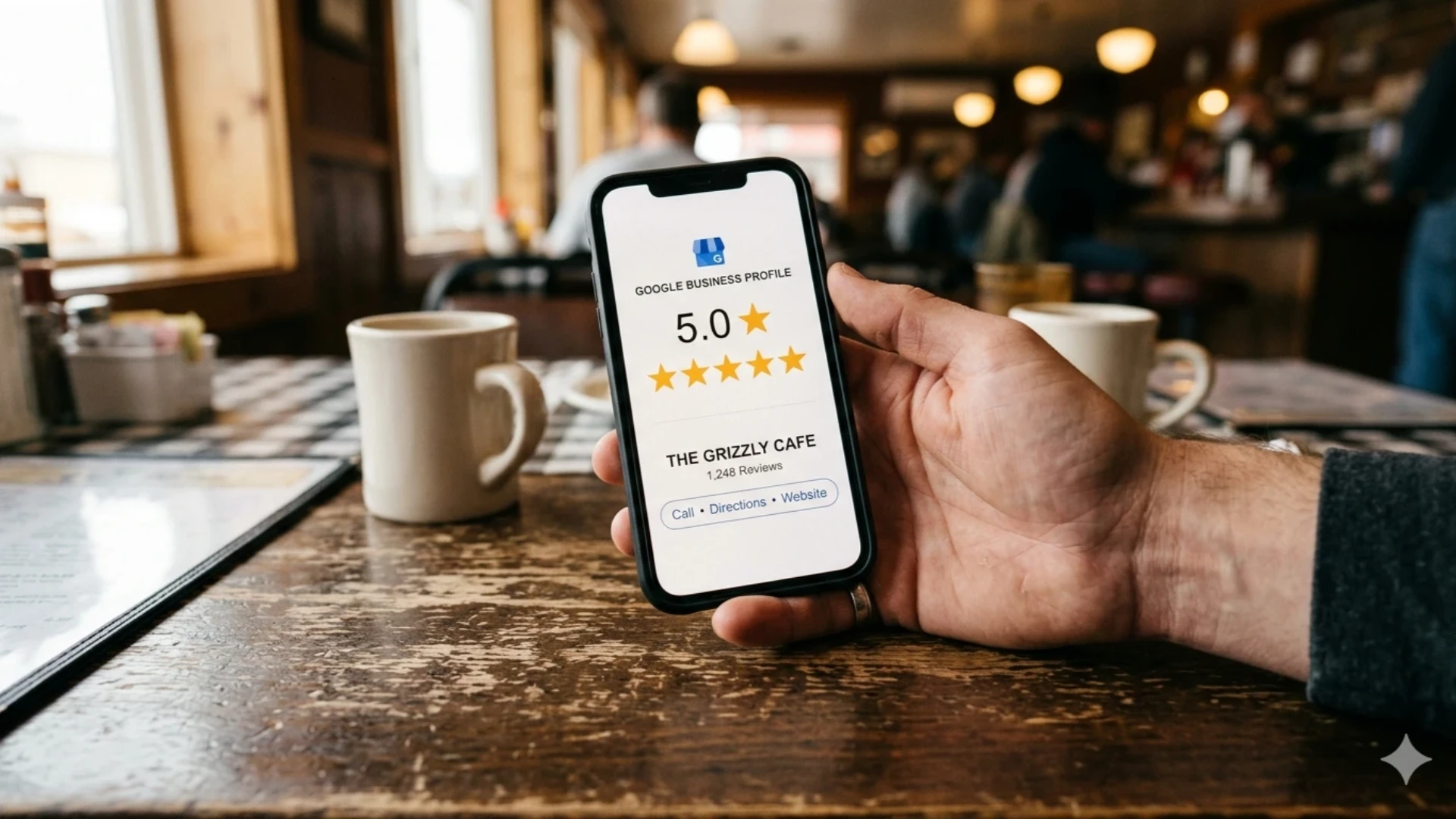
A potential customer hears your name from someone they trust. They nod, pull out their phone, search for your business, and spend about forty-five seconds looking at what comes up. They see your name, a handful of reviews, and the profile of a competitor right below you with three times as many. The competitor’s most recent review is from last week. Yours is from fourteen months ago.
They call the competitor. You never knew they were there. No alarm went off, no metric dipped, nothing felt any different. Just a job that was basically already yours, quietly walking out the door.
This happens more than most business owners realize. And the good news is it is one of the more fixable things in local marketing once you know to look for it.
Word of Mouth in Montana Didn’t Go Away. It Just Got a Second Step.
Montana has always run on reputation. In a state where the same names come up at every chamber breakfast, every co-op meeting, and every conversation at the end of a long job, trust travels fast and sticks hard. You have probably built most of your business on exactly that.
What changed, gradually and without much announcement, is that the person receiving a recommendation now almost always does one thing before they pick up the phone. They look you up. They read what strangers have said about you. They form an impression before you have said a single word. In our experience, business owners are often surprised to discover how much of that impression is already formed before the first call. The conversation your business is having online is happening whether you are paying attention to it or not.
What we see, again and again across Montana businesses, is a visibility gap. The trust exists. The reputation is real. It is just not showing up where people are actually making decisions.
What Your Reviews Are Actually Doing While You’re Not Looking
Most business owners understand that reviews reassure people who do not know them yet. What gets less attention is everything else happening at the same time.
A Google Business Profile with recent, consistent reviews gets treated differently by Google than one that has not moved in over a year. Recency affects whether you show up when someone nearby is searching right now. Quality matters too — Google looks at the language customers use, the sentiment behind it, and whether the business actually responds. A steady flow of thoughtful reviews from real customers carries more weight than a pile of one-liners collected in a single week.
Here is the part that surprises most people. Most businesses do not lose work because they have bad reviews. They lose it because they look inactive. A profile that has not moved in fourteen months does not look established. It looks forgotten. And in a forty-five second decision, forgotten and absent are effectively the same thing.
And it compounds in ways that are easy to underestimate. The customer who wrote that you were “straight with them from the first call” is still out there, still being read, still handing your next customer a reason to trust you before you have spoken a word. A review does not expire the moment someone hits post. It keeps working long after the job is done.
A Pattern We See More Often Than You Might Expect
We have seen this play out across enough Montana businesses that the details start to look familiar, even when the industries are completely different. The version we come back to most often involves a trades business in a smaller Montana city — the kind of operation that has been around long enough that its reputation genuinely precedes it.
Solid reputation. Fifteen-plus years in business. Loyal customers, steady referrals. Their Google profile had a couple dozen reviews, all positive, the most recent from about fourteen months prior. Nothing was wrong. Business was fine.
What they had not seen was that two competitors had spent the previous year quietly building their review profiles. One had roughly tripled its review count. The other had added a steady stream of recent responses that made the business feel genuinely human and easy to deal with.
For anyone searching for that type of service on a Thursday afternoon with a problem that needed fixing, our client was present but not prominent.
Over the following two quarters, with a simple and completely unglamorous process for asking satisfied customers to share their experience, the review count more than tripled. Local search visibility improved measurably. New customers started arriving already warm, already a little bit sold before the first conversation even started.
The owner’s reaction when we showed him the before and after was something along the lines of: “So this was just sitting there the whole time.” It was. And that is the part that stays with us every time we have that conversation — not the rankings or the numbers, but the moment a business owner realizes the reputation they spent years building was not quite showing up where people were actually looking.
Why the Number One Spot Is More Complicated Than It Looks
This tends to prompt a question we hear from almost every business owner at some point, usually with a slight edge of suspicion: “I searched for my own business and I wasn’t showing up at the top. What’s going on?”
Completely fair question. Also, unfortunately, one of the most misleading ways to measure how your business is actually performing — and here is why.
What matters most is not where you appeared on one search on one morning. It is whether the right people are finding you more consistently than they were six months ago. Everything else is noise. And here is why that single snapshot tells you so little.
Google is not showing everyone the same results. It is running a different calculation for every single person, based on where they are physically standing, what they have searched for before, and what your competitors happen to be doing at that exact moment. Think of it like this: two people searching for the same thing at the same time, one from their office and one from their truck three miles away, will likely see a different set of results. Checking your own ranking from your own desk is a little like asking your mum if your haircut looks good. Technically an answer. Not exactly objective.
A ranking that shifts is not automatically a sign that something went wrong. When we investigate ranking changes, the cause is usually something outside your direct control — a competitor becoming more active, a seasonal shift in search behavior, or an update that quietly changed how certain signals are weighted. That is the question we track on your behalf, so you do not have to spend your Tuesday mornings doing search checks and quietly worrying.
Not Sure Where Your Profile Actually Stands? Take The MarketingStack Challenge.
If any of this has landed somewhere uncomfortable — the fourteen-month-old review, the competitor quietly pulling ahead, the ranking that moves without explanation — that feeling is useful information. It means something is worth looking at properly.
The MarketingStack Challenge is a free working session where we map out what is actually happening with your marketing, identify where potential customers are dropping off or drifting elsewhere, and give you a clear set of next steps based on your specific business. No generic advice. No extra layers. Just a clear picture of where things stand and what is worth doing about it.
If your Google Business Profile is part of what you want to look at — and after reading this, it probably should be — that is exactly the kind of thing we work through together.
A Few Questions We Hear About This
What if someone leaves a bad review?
A thoughtful, human response to a critical review often does more for your reputation than the review itself does against it. People are not expecting perfection. They are watching to see how you handle things when something goes wrong. A bad review handled with honesty and a little grace tends to be quietly reassuring to everyone reading it — which is usually more people than you think.
We already have good reviews. Is this really worth keeping up with?
When review activity goes quiet, visibility starts to soften — particularly in local search, where recency is one of the signals Google uses to decide who to surface. The businesses that keep showing up consistently are almost always the ones that never stopped asking. Keeping the momentum going is considerably easier than rebuilding it after a long gap.
What is a realistic review pace for a small business?
There is no magic number, but a handful of genuine reviews each month is enough to keep things moving in the right direction. The goal is consistency over time rather than a big push followed by silence. A business adding three to five real reviews a month will outperform one that collected fifty in a week two years ago and has not moved since. Think of it less like a target and more like a habit.
I searched for my own business and I was not showing up at number one. Should I be worried?
See above re: asking your mum about your haircut. Searching for yourself from your own office is one of the least representative ways to measure your visibility. A more useful question is whether the right people are finding you consistently over time — and that is exactly what we track.
Is there anything about my Google Business Profile that matters more than reviews?
Actually yes, and most people find this genuinely surprising. Reviews are only part of the picture. How your profile is set up, what primary category your business sits in, and how consistently your business information appears across the weball play a significant role in local visibility. If you want to understand how your own profile holds up across all of those areas, our Google Business Profile optimization blog for Montana businesses is a worthwhile read.