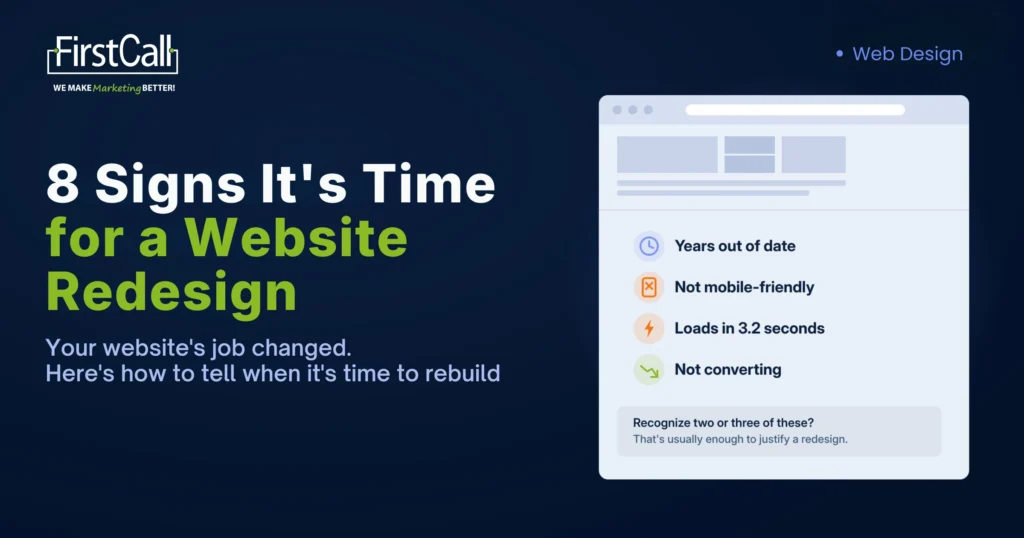

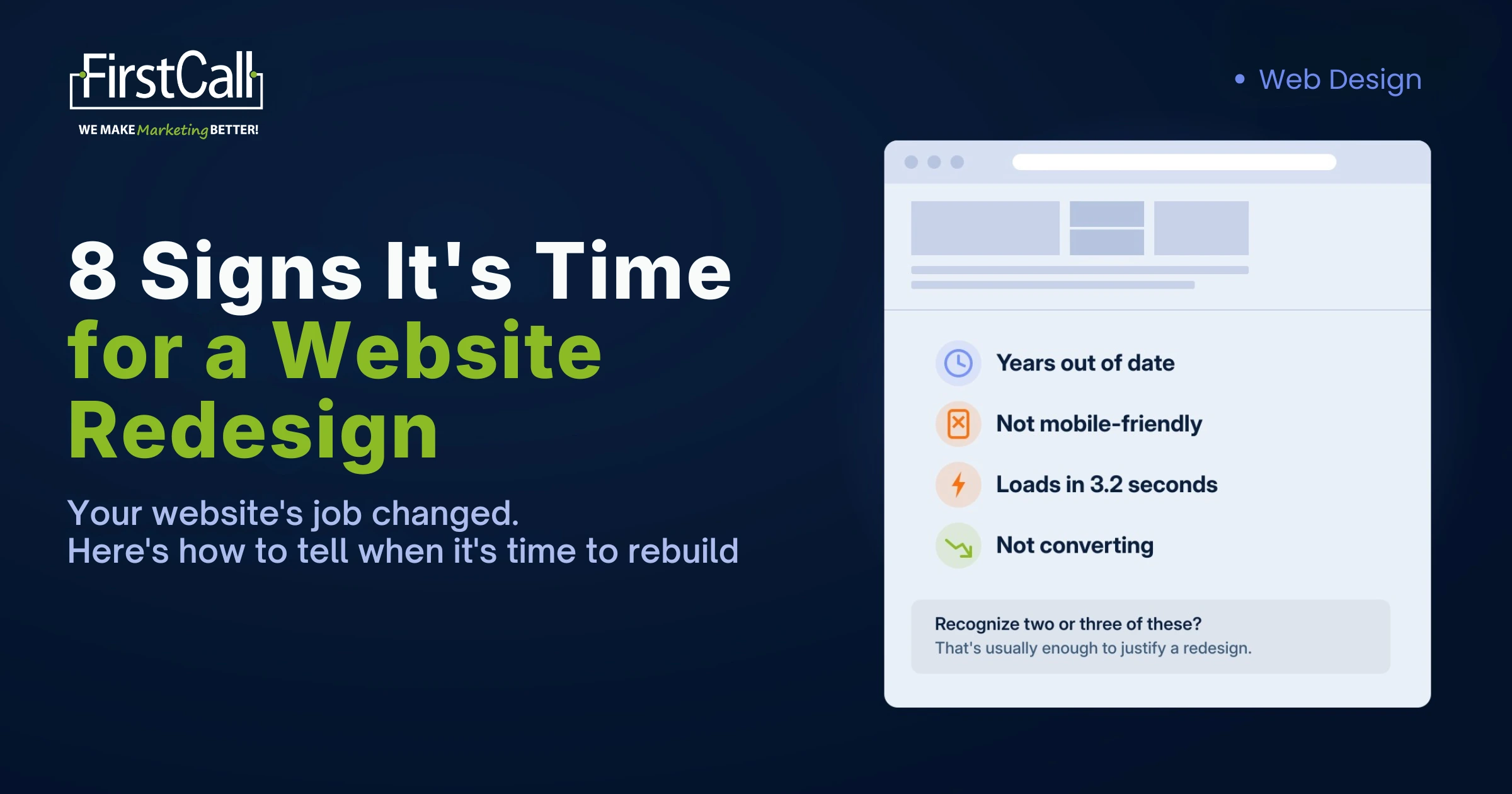
I get some version of this question from almost every new client before we start: “Do I actually need a whole new website, or can we just fix a few things?” There’s no universal answer, but there’s a reliable way to find yours. Look for these eight signs. If you recognize two or three, a redesign is worth serious consideration. If you recognize five or more, it’s not really a question anymore.
Why does this matter more than it used to?
Your website is still your storefront and your sales rep rolled into one, but the bar for what a good one does has moved. Roughly six in ten website visits now happen on a phone, and the three-second load-time benchmark Google established years ago still holds up in study after study: more than half of mobile visitors abandon a page that takes longer than that to load. Search itself has changed too. Google increasingly answers questions directly with AI Overviews pulled from page content, which means a site that’s hard for a person to read is often just as hard for the AI summarizing your business to understand, a shift I broke down in how to keep up with SEO and AI search. A website redesign in 2026 has more riding on it than one did even five years ago.
1. It looks outdated the moment someone lands on it
People form an opinion about a website almost instantly, long before they’ve read a word of it. If your site still carries design choices that were common a decade ago, cluttered layouts, tiny text, stock photography that doesn’t look like your actual business, that first impression is working against you before your content gets a chance to.
2. It’s not built for mobile first
Mobile isn’t an afterthought to design around anymore, it’s the primary way most people will meet your business online. A site that was designed for desktop and just shrinks to fit a phone screen usually shows it: text too small to read without zooming, buttons too close together to tap accurately, menus that don’t work well with a thumb.
3. It’s slow
Page speed affects both whether a visitor stays and whether Google ranks you well, and the two are more connected than most business owners realize. A few seconds of load time can be the difference between a visitor who sticks around and one who bounces straight to a competitor’s site instead.
4. It’s not showing up when people search
If your website isn’t ranking on Google, or isn’t getting mentioned in AI-generated answers when someone asks a related question, that’s rarely a mystery you have to solve blind. Broken technical SEO, thin or outdated content, and pages that never got structured for search all show up here. A redesign is the natural point to fix the technical foundation along with the look.
5. It doesn’t reflect your business anymore
If you’ve rebranded, added new services, or simply grown since your site was built, an outdated website actively works against the rest of your marketing. Customers expect what they see on your website, your social profiles, and in person to match. When it doesn’t, that mismatch reads as a red flag even if nothing is actually wrong.
6. Nobody on your team can actually update it
If changing a sentence, a photo, or your hours requires calling a developer and waiting days, your website is holding your business back in a very literal sense. A modern site should let you make routine updates yourself in minutes, not turn every small change into a project.
7. It’s not converting
A website that gets visitors but doesn’t turn them into calls, form fills, or bookings isn’t doing its job, regardless of how good it looks. This is often the clearest sign of all, because it’s measurable. If people are showing up and leaving without taking action, something in the path between arrival and conversion is broken.
8. Customers are already telling you
Sometimes the clearest sign isn’t a metric, it’s what people say. A customer mentioning they couldn’t find your hours, or a review that references how hard your site was to navigate, is direct feedback most businesses only notice if they’re looking for it. If you’ve heard some version of this more than once, take it seriously.
Do you need all eight to justify a redesign?
No. Two or three of these, especially speed, mobile experience, and conversion, are usually enough on their own to justify starting the conversation. The rest tend to show up together once a site has aged past its useful life, so recognizing several at once is a strong signal the whole site needs rebuilding rather than another round of small fixes.
Where to start if this sounds familiar
Start by looking at your own site the way a new customer would: pull it up on your phone, on a slow connection if you can manage it, and try to do the one thing you most want a visitor to do. If that’s frustrating for you, it’s frustrating for them too.
From there, our web design and development work is built around fixing the whole picture at once, not just the parts that are easiest to see. Not sure whether your site needs a full redesign or something smaller? That’s exactly what our free MarketingStack Challenge is built to figure out.
Quick answers
How do I know if I need a full redesign or just a refresh? If you recognize two or three of the signs above, especially anything related to speed, mobile experience, or conversions, a redesign is worth investigating. A refresh works when the underlying site is solid and only the surface needs updating.
How often should a website be redesigned? There’s no fixed number of years that applies to every business. What matters more is whether the site still performs well on mobile, loads quickly, and converts visitors, since a newer site with those problems needs attention just as much as an older one.
Will a website redesign hurt my SEO rankings? Not if it’s done properly. A good redesign preserves what’s already working, your URLs, your existing rankings, your page content that performs, while fixing the technical and design issues that were holding the site back.