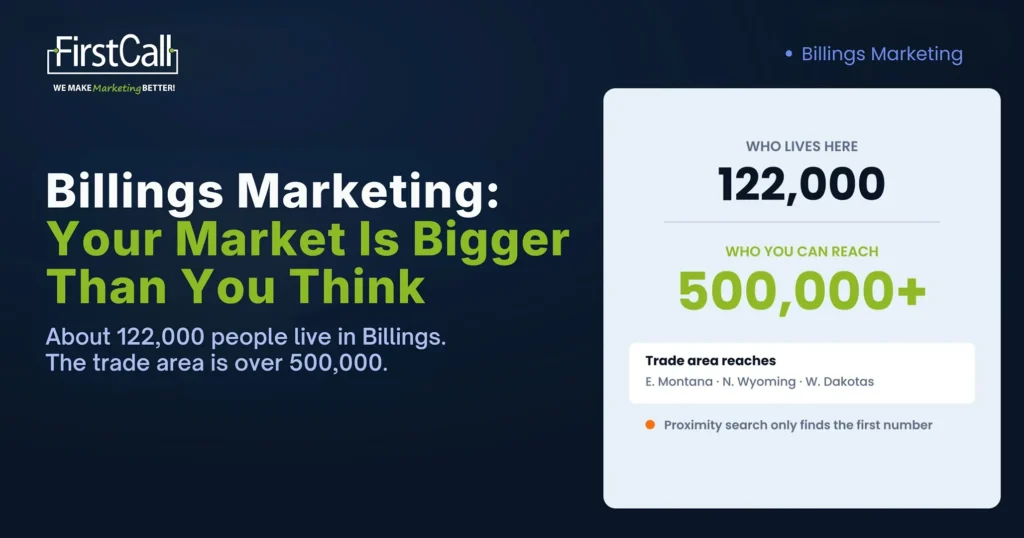
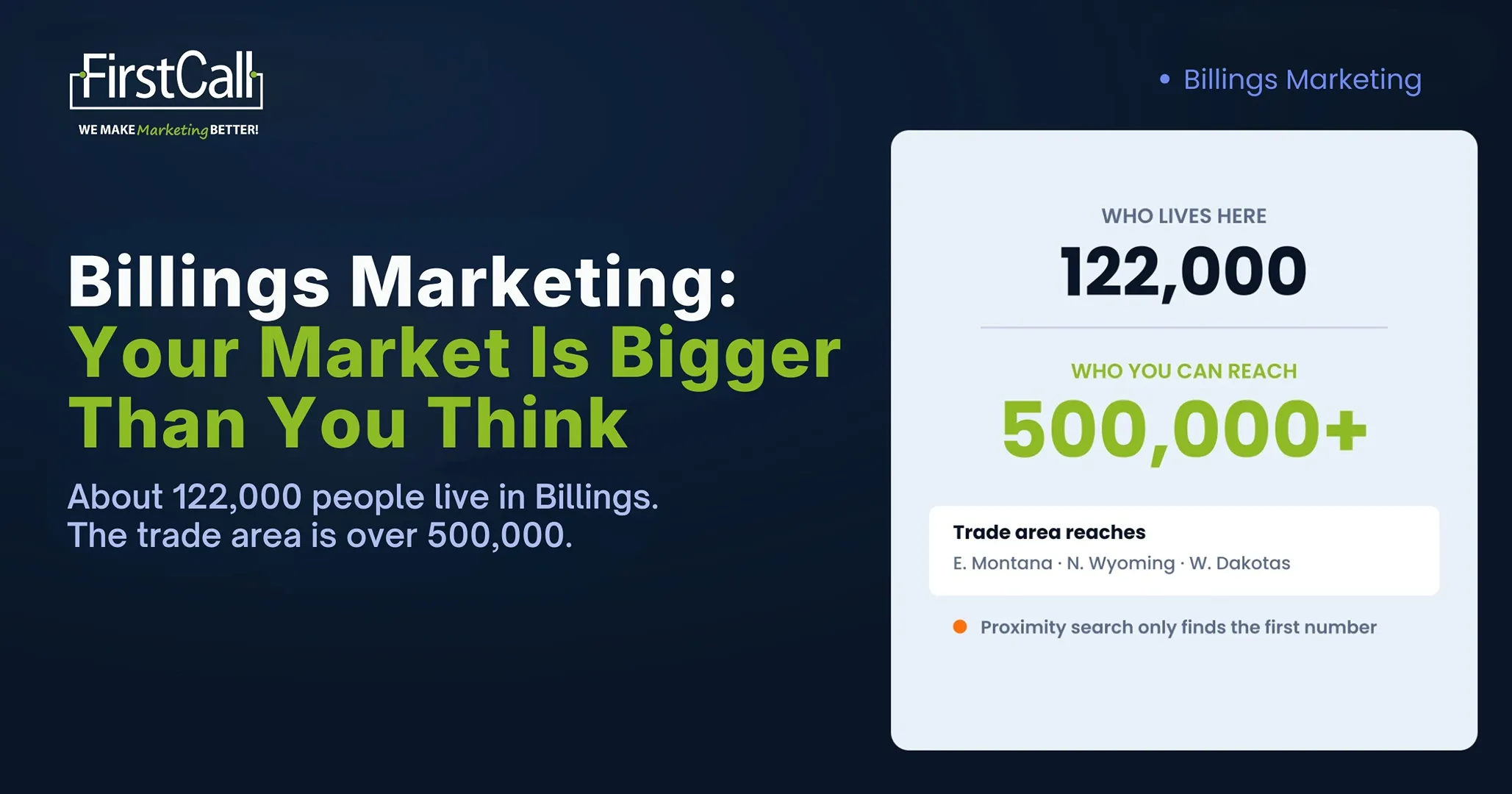
About 122,000 people live in Billings. The trade area the city actually serves is over 500,000, stretching across eastern Montana, northern Wyoming, and into the western Dakotas. That’s one of the largest trade areas in the country, according to the City of Billings itself.
Most Billings businesses market to the 122,000 and never think about the rest. That gap is what I want to talk about.
Why Billings works differently from the rest of Montana
I’ve written before about how Missoula customers choose between similar businesses, and that piece holds up for a market where most of your customers live within a few miles of you. Billings isn’t that market.
Billings is a regional hub, and that changes everything. Healthcare here operates as a referral center for a radius of several hundred miles. Retail draws people who cheerfully drove two hours to get to it. Professional services, equipment dealers, specialty trades, all of them routinely serve clients who visit once or twice a year at most, and who started looking from a town you’d genuinely need a map to find.
That changes the marketing question. It’s no longer just “how do I stand out among nearby competitors.” It’s “how do I get found by someone who isn’t nearby at all, and who has no reason to know I exist.”
Proximity-based local SEO undersells you here
Standard local SEO advice optimizes for “near me” searches, and it works, up to a point. Google weighs proximity heavily in local results, which means someone searching from Sheridan or Miles City may never see the Billings business that would serve them best.
For businesses whose real catchment extends well past the city limits, that’s a structural problem, not a you problem. You can be doing everything right and still be invisible to a large share of the people you could genuinely help, which is a frustrating way to run a business.
The businesses that solve this stop relying only on proximity signals and start building content that answers questions from across the region. A page about a service specifically for ranch operations reaches somebody in Roundup that a generic services page never will. A piece answering a question a Wyoming customer would ask travels further than a homepage optimized for “Billings.”
Your Google Business Profile still matters, just differently
For someone already in Billings, your profile is the storefront. For someone three hours out, it’s proof you exist and are worth the drive.
Two things matter more in a regional market than a purely local one. First, your service area settings, which are often left at the default and quietly limit who Google shows you to. Second, your reviews, because a customer weighing a two-hour trip needs more reassurance than someone deciding between two places on the same street.
That’s also why recent reviews carry disproportionate weight here. Somebody planning a trip wants evidence you were good this month, not evidence you were good in 2023. I broke down how to get more of them in getting reviews online.
The healthcare and energy factor
Billings has an unusual economic shape. Healthcare is the largest employment sector, driven by the referral hub role. Energy and refining sit alongside it, plus agriculture and the wholesale trade that feeds it.
If you sell to businesses here, that mix matters more than general marketing advice suggests. The buying cycles are different, the seasonality is different, and the person you need to reach at a ranch supply operation is not reachable the same way as someone at a medical practice.
That’s an argument for narrower marketing, not broader. A page written for one of those sectors will outperform three pages written for everyone, because it says something specific enough to be believed.
What I’d do first if I ran a Billings business
Start by checking whether Google even knows your real service area. Open your Google Business Profile and look at the service area settings, not just your address. I’ve lost count of the businesses serving a 200-mile radius who have never once told Google as much.
Then search for what you do from outside the city. Use a tool or ask someone in Hardin or Powell to search and tell you what they see. You may find you rank respectably in Billings and nowhere else, which is useful and slightly alarming information.
Then read your website with a regional visitor in mind. Does anything on it acknowledge that you serve people outside Billings? Is there a single page that would make sense to someone sitting in Wyoming? For most businesses the honest answer is no, and happily, that’s a gap you can close without spending a thing.
Where this gets easier with help
None of the above requires an agency. It requires an afternoon and a willingness to look at your own listings properly, which is less fun than it sounds but considerably cheaper than the alternative.
Where it does get harder is figuring out which of those gaps is actually costing you customers, and in what order to fix them. That’s what our free MarketingStack Challenge is for. We look at your site, your search presence, and your profiles, and tell you plainly what’s holding you back. No cost, and no obligation to do anything about it.
If the answer turns out to be the website itself, our web design and development work handles that end. If it’s visibility, that’s the longer game, and our SEO authority building work is built for it. You can also see how we approach digital marketing in Billings specifically.
Quick answers
Is marketing in Billings different from marketing in other Montana cities? Yes, mainly because of scale. Billings serves a trade area of over 500,000 people across multiple states, so businesses here can reach customers well beyond the city. Marketing built only for local proximity leaves a large part of that reachable audience untouched.
How do I reach customers outside Billings? Set your Google Business Profile service area to reflect where you actually work, then create content that answers questions specific to the regions and industries you serve. Proximity-based search favors people close to you, so content is how you reach everyone else.
What industries drive the Billings economy? Healthcare is the largest employment sector, supported by Billings acting as a regional referral hub. Energy and refining, retail and wholesale trade, and agriculture round out the mix. If you sell to businesses, marketing built around one of those sectors usually outperforms general messaging.