Every Montana business owner who calls me about Google Ads asks the same question first: “How much do I need to spend?” It’s the wrong first question, and answering it too early is how most first-time Google Ads budgets get wasted.
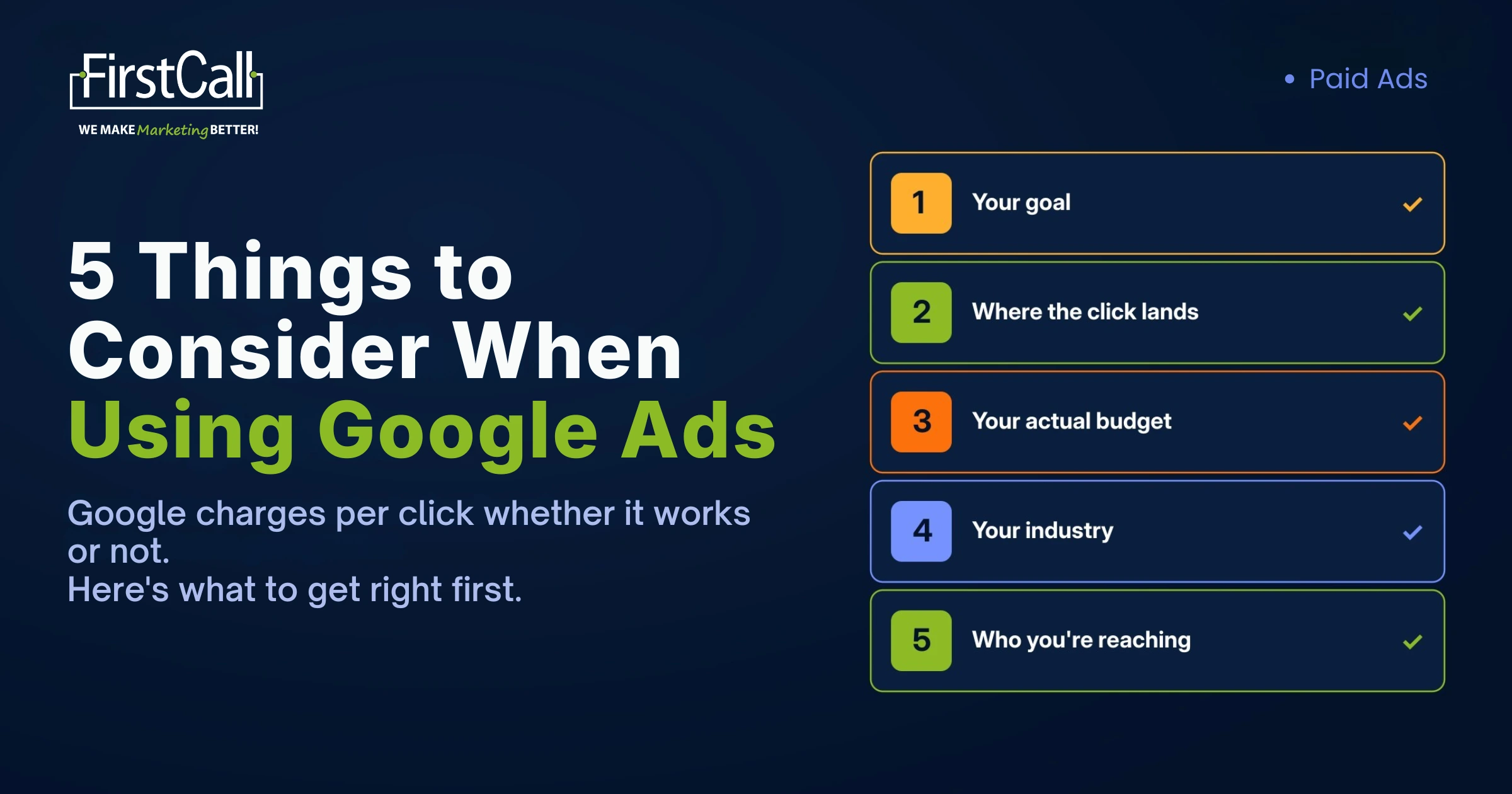
The real first question is whether the five things underneath a Google Ads campaign are actually in place. Budget is one of them, but it’s the fourth one, not the first. Get the first three wrong and no budget fixes it.
What decides whether Google Ads works?
Google Ads charges you the moment someone clicks, whether or not that click ever turns into a customer. The platform doesn’t know or care if your landing page makes sense, if your budget matches your market, or if you’re chasing the right keywords for your business. That part is entirely on you, and it’s exactly where most small business campaigns quietly bleed money.
The average cost per click across industries sits around five dollars right now, according to WordStream’s 2026 benchmark report, though the real range runs anywhere from about one dollar to nine or more depending on the industry. Legal and insurance keywords sit at the expensive end. Home services and retail usually sit in the middle. Whatever
1. Your goal, stated as one specific action
“Get more business” is not a goal Google Ads can optimize toward, but a phone call, a form fill, or a booked appointment is. Before you set a single keyword, decide the one action you want someone to take after they click, and make sure your account is set up to track it.
This sounds obvious, and it’s the single most skipped step I see. It’s alarmingly common for a new account to have thousands of dollars in spend before anyone connects conversion tracking, which means nobody can say which keywords, ads, or days of the week are actually producing customers. The money isn’t wasted because Google Ads failed. It’s wasted because nobody told the account what success looked like.
2. Where the click lands
A Google Ads click costs money the second it happens, so where it sends someone matters as much as the ad that earned it. If your ad promises a free estimate and the click lands on your homepage instead of a page about estimates, you’ve paid for a visitor who now has to go hunting for what you told them they’d find.
A landing page that matches the ad’s promise, loads fast, and gives someone one clear next step will out-convert a prettier page every time. This is also where AI search is quietly raising the bar: Google’s AI Overviews now pull directly from page content when they summarize a business for a searcher, an angle I broke down in how to keep up with SEO and AI search, so a vague or generic landing page underperforms in more places than just your ad account.
3. Your actual budget, not a wished-for one
Google asks for a monthly budget, not a fixed number of clicks, so plan around dollars rather than a specific click count you’re hoping to hit. WordStream’s 2026 data puts the typical small business starting budget between $1,000 and $2,500 a month, though your own number should come from your numbers, not a benchmark. What can you afford to spend to earn one new customer, and how many of those can you comfortably fund in a month while you learn what’s working?
Set that number, run it for at least a few weeks, and resist the urge to panic-adjust daily. Google Ads needs a real sample of clicks before its own optimization has anything to learn from.
4. How crowded your industry is
Your industry decides how expensive your keywords are and how much your ad needs to stand out to earn a click at all. A roofer in Missoula is bidding against a much smaller, more local field than a personal injury attorney bidding nationally, and that difference shows up directly in cost per click.
It’s worth knowing what your specific competitors are doing, not just your industry’s average. A quick look at their ad copy and the keywords they’re chasing tells you where the real competition sits, and sometimes where the openings are that your competitors haven’t bothered to claim yet.
5. Who you’re trying to reach
A Google Ads campaign built for Missoula behaves nothing like one built for Los Angeles, and the difference goes well past budget. Location targeting, the age and habits of your typical customer, and even the time of day people in your market are searching all shape a campaign that a generic setup will miss entirely.
You can target by location, and depending on the data available, by age, gender, and household income too. None of that is guesswork you have to do alone. It’s information Google Ads gives you access to, and ignoring it is one of the more expensive mistakes a new account makes.
So who should run your campaign?
Once these five things are genuinely settled, the last decision is who manages the account day to day: you, an employee, or an agency. A small, tightly-run campaign is genuinely manageable in-house if someone has the hours to give it real attention every week, not just at setup. Where owners usually get burned is treating it as a “set it up once” project, when Google Ads rewards ongoing attention far more than a perfect first draft.
If that weekly attention isn’t realistic for your team, a local agency that already understands your market tends to outperform a national firm that’s learning your city for the first time. That’s exactly the gap our Paid Ads work is built to close for Montana businesses. Either way, the five things above matter more than who’s logged into the account. A skilled manager on top of a fuzzy goal and a mismatched landing page is still just an expensive way to find out what doesn’t work.
Not sure which of the five is actually costing you right now?
That’s exactly what our free MarketingStack Challenge is built to find.
Quick answers
How much should a small business budget for Google Ads? Most small businesses start between $1,000 and $2,500 a month, though the right number depends on your industry’s cost per click and how many new customers you can comfortably handle. Start with what you can afford to learn from, not a number you saw in an article.
What’s the biggest mistake first-time Google Ads accounts make? Turning on ads before deciding what a “successful click” actually looks like. Without a specific goal and conversion tracking connected, you can spend real money and still not know which keywords or ads are producing customers.
Do I need a new landing page for Google Ads, or can I use my homepage? A dedicated page almost always performs better. If your ad makes a specific promise, whether that’s a free estimate, a same-day appointment, or a particular service, the page behind the click should be about exactly that, not a general homepage the visitor has to search through.