
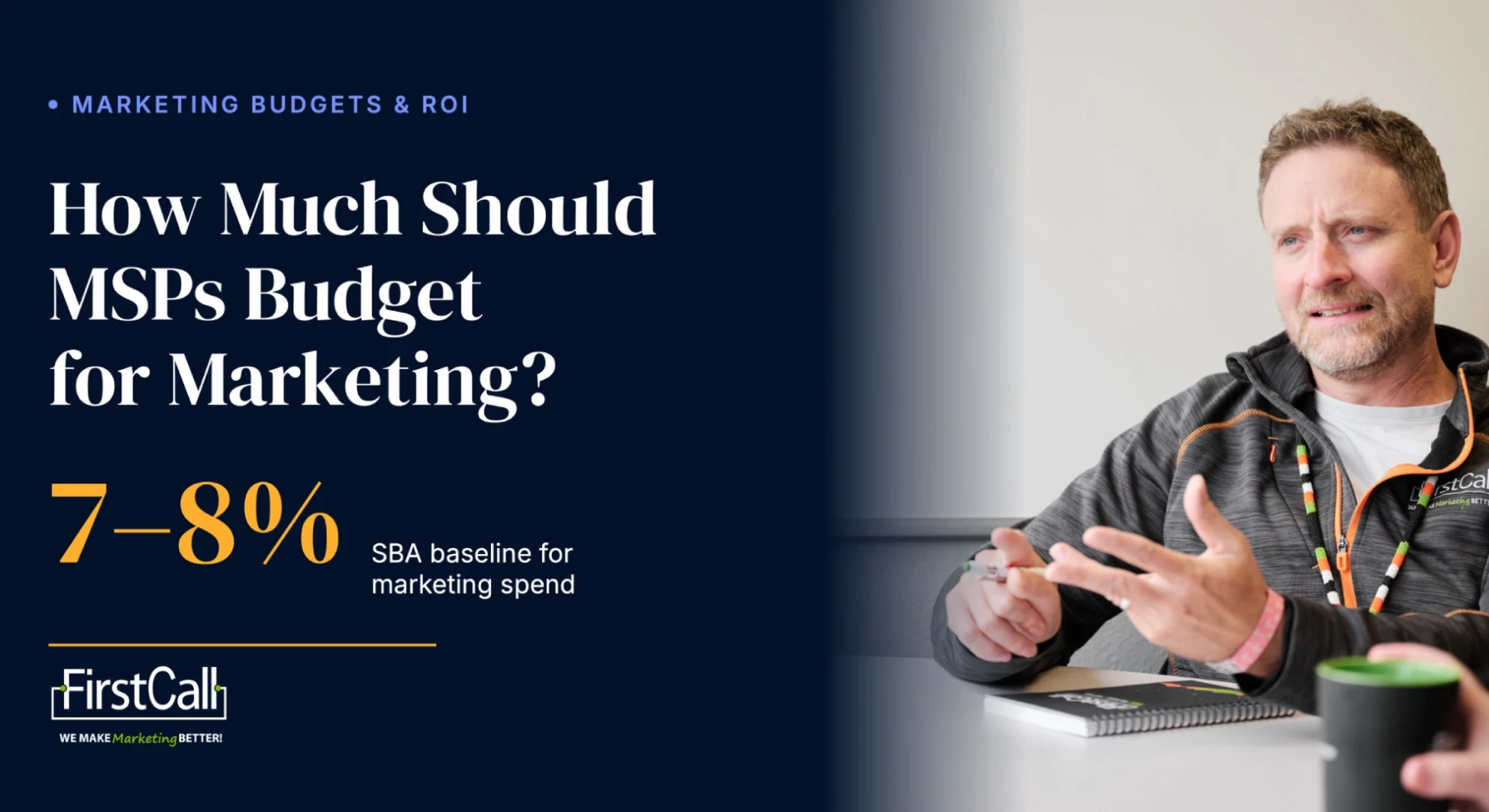
Here is the direct answer: the U.S. Small Business Administration recommends 7 to 8 percent of gross revenue for businesses under $5 million, and broader industry surveys put the typical range closer to 5 to 10 percent depending on company size and growth stage. MSPs tend to sit at the higher end of that range for an honest reason, the long, trust-heavy sales cycle MSPs deal with. A restaurant can win a customer with one good ad. An MSP is asking a prospect to hand over their entire IT infrastructure, and that decision takes months of consideration, not a single impulse click.
Where does most of an MSP marketing budget go?
Two categories eat the largest share, and they are not the ones most owners expect. The first is content that demonstrates real expertise, case studies, technical explainers, LinkedIn thought leadership, because generic service pages no longer carry weight with either prospects or search engines. The second is steady paid visibility, LinkedIn ads in particular, since that is where IT decision-makers spend their attention, more than general social platforms.
Ad spend itself varies widely by market and competition, and there is no single number that fits every MSP. What matters more than the exact figure is consistency. A campaign that runs for three months and then gets paused when a quarter feels tight almost always underperforms one that runs at a smaller, steady budget year-round, because MSP buying decisions form slowly, over repeated exposure, not in a single session.
Which marketing costs are one-time versus ongoing?
Not everything in a marketing budget recurs monthly. Photography, a brand refresh, or a properly produced case study video are one-time investments that then get reused for years across your website, LinkedIn, and sales materials. Recurring costs, ad spend, content production, review management, are the ones that need a steady monthly line item rather than a once-a-year push.
The mistake we see most often is treating the one-time investments as recurring and the recurring investments as one-time, a business builds one case study, uses it forever without updating it, and treats their ad spend as something to switch on before a slow quarter rather than a steady, ongoing commitment.
Where should a budget-constrained MSP start?
If the higher end of that range is not realistic yet, the order you build in matters more than trying to do everything at once. Start with two or three strong case studies. These are one-time costs that keep paying off for years, and they are what everything else depends on. Next, make review generation and Google Business Profile activity a habit rather than an occasional task, since this is low-cost relative to almost everything else on this list and directly affects how you show up in search.
Only once that foundation exists should ad spend, LinkedIn in particular, enter the plan. Sending paid traffic to a page that reads like every other MSP’s website wastes the spend before it has a chance to work, so the content needs to exist first. Reversing this order, ads before there is anything specific to show, often produces poor returns, and it can be easy to blame the ad platform itself when the real issue was what the ads were pointing to.
How should MSPs think about annual versus monthly budgeting?
An annual budget gives you the roadmap: how much you are allocating for the year, and what major projects (a website rebuild, a new case study library, a conference presence) need to be planned for ahead of time. A monthly budget is where the actual adjustments happen, shifting spend toward whatever channel is producing results this quarter, whether that is LinkedIn ads, content, or local search visibility if you serve a specific region.
Revisit the monthly breakdown quarterly at minimum. MSPs that only look at their marketing budget once a year tend to keep funding whatever channel they started with, even after it has stopped performing, simply because nobody revisited the plan.
What does doing nothing cost an MSP?
This question is easy to overlook, and it matters more for MSPs than almost any other industry. Without consistent marketing, an MSP’s pipeline depends entirely on referrals and word of mouth, which is not a predictable growth strategy, and it leaves you especially exposed during a slow referral quarter with nothing else in the pipeline to fall back on. Given how long an MSP sales cycle already runs, a gap in your marketing today does not show up as a revenue problem until six or twelve months from now, which is exactly why it is easy to underinvest without noticing the cost.
FAQ
Is there really a fixed percentage MSPs should spend on marketing? Not a fixed one. The SBA’s 7-8% guideline is a reasonable starting reference point for businesses under $5 million in revenue, not a rule. A newer MSP building initial trust and visibility may need to spend closer to the higher end of the broader 5-10% industry range, while an established one with strong referral flow may sustain growth on less. Revisit the number as your pipeline changes rather than treating it as fixed once you set it.
Should MSPs spend more on ads or on content? Both matter, but content is what makes ad spend work harder. An ad sending traffic to a generic service page converts far worse than one sending traffic to a specific case study or expertise-driven page, so if you have to prioritize one first, build the content foundation before scaling ad spend.
How do I know if my current marketing budget is enough? Look at whether your pipeline depends mostly on referrals. If it does, that is usually a sign your marketing budget is underfunded relative to what consistent growth requires, not that referrals are simply working well. A Total Online Presence Audit is a straightforward way to get a specific answer rather than guessing.
Budgeting for marketing is less about hitting an exact percentage and more about being consistent enough, in the right places, that your pipeline does not depend entirely on luck and referrals. If you want a clear read on where your own marketing spend should be going, the MarketingStack Challenge is a free 30-minute session built for exactly that.