

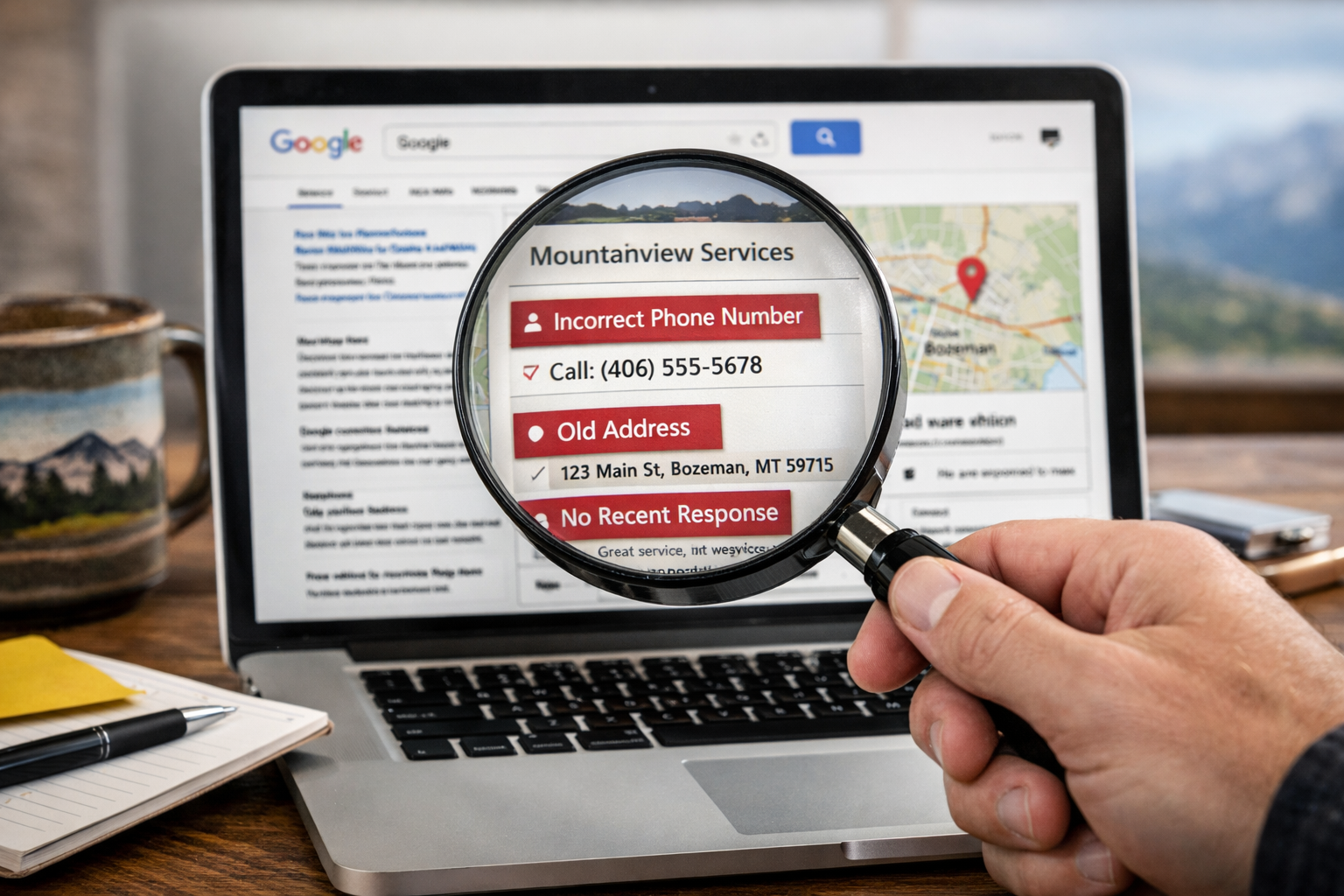
Most Google listings look fine until you try to get a customer to actually do something from them.
The other day, we were talking with a business owner here in Montana who said, “We show up when you search our name, so I think we’re good.”
So we pulled it up together.
The phone number was wrong.
There were two listings for the same business.
A recent review was sitting there with no reply.
Then we clicked through to the website, and that’s where it got interesting. The services on the site didn’t match what the listing was saying.
That gap is where a lot of businesses lose people without realizing it.
Create Your Google My Business Listing
Let’s run through the checklist and keep things as simple and brief for you as possible. Here we go:
- Choose your Name, Address, and Phone Number (NAP) – make sure this information is consistent across all of your online listings. For example. don’t use “First Call – Web” for your Google listing and then use “First Call – Websites” for your Facebook. Keep it consistent!
- Follow this link to Create Your GMB Listing.
- Follow the prompts to add in your basic NAP for your listing. If your business already exists then Google will prompt you to claim it using either a postcard or phone call. If you are creating a listing, you may need to work through this verification as well.
- If necessary, create a business-only gmail to tie to the listing. Why? In case you want someone to update this listing in the future, you won’t have to give them your personal gmail to do the update.
- Voila! You have created a basic GMB listing.
What Now?
You’ve knocked out the most basic step to get your GMB listing. This listing is used by Google to display in its Maps and Google Searches. You can leave this as-is and be happy you’ve made it this far or you can take it to the next level by uploading images, videos, descriptions, and posting regularly to this listing as you would a social account.
According to Google, “Businesses that add photos to their Business Profiles receive 42% more requests for directions on Google Maps, and 35% more clicks through to their websites than businesses that don’t.”
Google will favor your listing if you show that you update it regularly. Likewise, you should absolutely check this listing regularly for Google Reviews. These reviews should always have a reply since this is a feature of Local SEO. Likewise, encouraging customers to leave a review here can also help you rank better overall.
There is a lot you can do to boost your Local SEO overall but this is one thing some businesses overlook. Don’t miss out! It only takes a few minutes. Go do it now!
But what if I already have a Google Listing?
You created your Google listing. It just never turned into anything.
Most businesses do go through the setup process.
You claim the listing, verify it, add your hours, maybe upload a logo. At that point, it feels like you checked the box and can move on.
But then a few months go by and you start noticing things that don’t quite add up.
You search for your service in your area and you’re buried under competitors you know aren’t better than you.
You see traffic in your reports, but the phone isn’t ringing the way you expected.
Someone mentions they couldn’t figure out if you were open or not.
We’ve seen this pattern enough times that it’s usually not a mystery. The listing exists, but it isn’t being managed in a way that actually supports how people search and decide.
Where this starts to break
One of the most common issues is something that seems small on the surface.
Your business name, address, and phone number aren’t consistent everywhere.
We’ve seen situations like this:
- The Google listing says one version of the name.
- Facebook uses a slightly different variation.
- A local Montana directory still has an old phone number from a few years ago.
Individually, none of that feels like a big deal. Together, it creates uncertainty.
Google is trying to decide which information is correct. When it sees differences, it becomes less confident about your business. That hesitation shows up in where you rank.
Another situation that comes up more than you’d expect is duplicate listings.
Someone created one a long time ago.
Another one was generated automatically.
Now both exist, neither is fully accurate, and your visibility is split between them.
We’ve had clients come to us thinking their listing was underperforming, and it turned out they were unknowingly competing with themselves.
This is where most people get frustrated
A business will put effort into their Google listing and expect to see movement.
They add photos.
They write a better description.
They start asking for reviews.
Then nothing really changes.
In our experience, that’s because the listing is being treated like a standalone task.
It isn’t.
Your Google listing is tied directly to your website and every other place your business shows up online.
We’ve reviewed listings that were well put together, but the website they linked to didn’t support any of it.
- No clear service pages.
- No mention of the locations they actually serve.
- No real explanation of what the business does beyond a headline.
So Google has mixed signals, and the person clicking through doesn’t get enough clarity to take the next step.
What we’ve seen actually work for Google Listings
When things start improving, it’s usually not because of one change. It’s because everything starts lining up.
NAP consistency across every listing
This is one of those things that feels tedious until you see the impact.
We’ve worked with Montana businesses where:
- An old address was still listed on a directory
- A tracking phone number was used in one place but not others
- The business name had small variations depending on the platform
Once that was cleaned up, rankings became more stable. Not overnight, but noticeably more consistent.
A listing that looks active, not abandoned
You can tell when a listing hasn’t been touched in a while.
You open the listing and it feels like no one’s touched it in months. The last photo is outdated, there’s nothing recent posted, and a review from earlier in the year is still sitting there with no reply. That’s usually the moment a customer hesitates, even if they don’t consciously realize why.
From a customer’s perspective, it raises questions about how engaged the business is. From Google’s perspective, it doesn’t send strong signals that the listing is being maintained.
We’ve seen businesses start getting more calls after doing fairly simple things.
Uploading real photos of their work instead of stock images.
Posting updates every so often.
Responding to reviews in a way that sounds like an actual person wrote it.
It doesn’t require a huge time investment. It just requires not letting it sit.
Reviews that actually get a response
One situation we run into often is a business with solid reviews that are just left there.
No replies. No acknowledgment.
Or there’s a negative review, and it’s been sitting untouched for months.
Customers read those. They pay attention to how you respond.
We’ve seen cases where the number of calls increased without adding more reviews, simply because the business started engaging with the ones they already had.
A website that backs everything up
This is where a lot of listings fall short.
If your Google listing says you offer a service in Missoula or Bozeman, your website needs to clearly support your overall SEO/AIO/GEO outreach.
We’ve looked at sites where:
- There’s a single generic services page
- No location-specific information
- No clear next step for someone ready to reach out
So even when the listing does its job and gets the click, the website doesn’t carry it any further.
That’s usually where conversions drop off.
Ongoing updates instead of a one-time setup
A common situation is treating SEO like a project with an end.
You set everything up, check it off, and move on.
What we’ve seen instead is that the businesses who keep showing up are the ones who keep things moving.
They add photos over time.
They continue asking for reviews.
They update their site when services change or expand.
It’s less about doing everything at once and more about not letting it go stale.
What an optimized Google Listing looks like in practice
We worked with a service business in Montana that, on paper, looked like they had everything covered. Their listing was verified, they had a solid number of reviews, and the website was live, so there wasn’t an obvious reason things weren’t working.
But leads were inconsistent, and that’s where they started getting frustrated.
When we dug into it, the issues weren’t dramatic. Their business information didn’t match everywhere it showed up online, the Google profile hadn’t been touched in a while, and the website didn’t do a great job explaining what they actually offered or where they worked.
Individually, none of that felt like a dealbreaker. Together, it created just enough friction that people weren’t taking the next step.
Once those pieces were aligned, things started to feel more predictable. They weren’t second-guessing where calls were coming from, and the conversations they were having with customers were clearer from the start.
Nothing about it felt like a big win in the moment. It just started working the way they thought it would have from the beginning.
A simple way to look at it
Your Google listing is often the first place someone interacts with your business.
Your website is where they decide if they’re actually going to reach out.
And let’s not forget about how your socials and website should work together.
Everything else, your directories, your citations, your presence across the web, reinforces whether they trust what they’re seeing.
When those pieces don’t line up, results feel unpredictable.
When they do, you stop guessing where leads are coming from.
If you’re not sure where yours stands
A lot of business owners assume things are fine because nothing is obviously broken.
Then you look a little closer and start noticing small issues that add up.
Search for your business.
Click through your listing.
Look at your website like someone seeing it for the first time.
If anything feels unclear or inconsistent, there’s usually something behind it.
If you want us to walk through it with you, that’s exactly what we do in our FREE marketing & website assessment. Happy to show you what it looks like for your business.